28 July 2009

Busy as a bee

Been canning and harvesting for the market garden this week, so I'll leave you with some pictures from the garden.

Bumble bees are in abundance this summer, busy pollinating the garden. This one was snoozing in the Meadow Sweet, beauty rest.

Some of my favorite predators. We have had more aphids this year than normal, never to pest levels, but it has kept the Lady Beetles eating and breeding in the garden. We have about 4 distinct Lady Beetle species, and each look distinct in their larval stage as well.

I think this is the Seven-Spotted Lady Beetle larva, the commonly recognized red beetle with seven black spots.

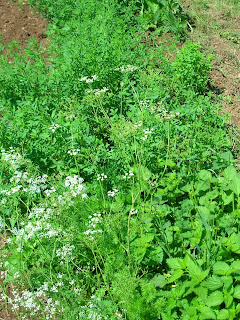
The blooming of the carrot flowers always seem to hearald the first Tachinid flies of the season. Welcome.

And this is the first Green Lacewing I've seen in our garden, probably due to the attractive numbers of aphids this year.

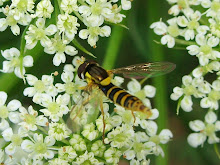
Syrphid Fly, again in the carrot flowers. A welcome parasatoid.

We also have a family of Garter Snakes in the hay bale shelter, originally left for the toads. Still plenty of toads in the garden, but there was one particularly fat Garter Snake that probably didn't get fat on slugs alone. Hopefully the snakes don't get all the toads! Both the snakes and the toads have been keeping the numerous slugs in check this wet summer.

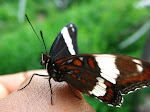
Our very own Fritillary visited our garden. Too bad it picked a rather ragged looking Cosmo flower for it's close-up shot.

The Hollyhocks are blooming, and were buzzing with Bumble Bees this morning.


As are the poppy flowers. Gorgeous to grow, and delicious seeds for the kitchen as well.

23 July 2009

Growing by degrees

The food cycle has finally reversed flow, there is more food coming into the house than we are able to eat... time to stock the pantry. Without a greenhouse, our stored food supplies need to last until the third week of July. It can be a struggle, and usually means relying on spring greens, grains, eggs and dairy for the better part of June and July after the last of the root crops and potatoes. And I always put away more than enough canned green beans to cover the gaps before those first glorious snow peas are ready in early July.

Although we planted each of these crops about three weeks earlier than last year, our first harvests are no more than a week to a few days earlier. I, of course, had my hopes up for a logical three-week-earlier harvest. But every season is unique. In doing some research, I happened across the phrase "Growing Degree Days". It is a unit used to measure or predict the first bloom or maturity of a crop, or the emergence of an insect or pest. Temperature is one of the most crucial elements in crop growth, and generally triggers most of the cycles of the insect world. And we have had an abnormally cool June and July. Especially July. Our nights have averaged at 10C (50F) instead of the normal 16-18C (60-65F). Only a few crops will continue to thrive with these nighttime lows, such as peas and Cole crops. Roots, onions and potatoes slowed down. And heat lovers: beans, tomatoes, peppers, squash and cucumbers just hung around, waiting.

Growing Degree Days can easily be calculated (go to the link above at Wikipedia), by keeping track of the maximum and minimum temperatures, which I have been doing for years, in my garden records. Each crop or insect has a cumulative requirement of heat, or Growing Degree Units to flower, reach maturity or hatch out. It will be interesting to use this unit in the future, to calculate and predict crop maturity or expected pest emergence, in an ever changing climate.


According to planting dates, we should have had our first new potatoes July 1st, instead of July 22nd, which shows that the cool weather set back the growing season by three weeks. Quite significant. But our first taste of potatoes, since the last wrinkled-ones in mid-June, was well worth the wait: Yukons, one large golden potato snuck out from each plant in a row. Boy they taste good. It's kind of a nice break, not eating potatoes in the gap between the last wrinkled, sprouting aliens, and the new, apple-crisp crop. Like cleaning the palette. After all, we do eat our share of potatoes over the winter. And come June we have an abundance of eggs so I can make all of the pasta I dreamed of making in the winter egg-drought.

Likewise, there is nothing like that first sun-warmed tomato... We savored, half each, on a bed of lettuce and snow peas, with a yogurt-dill-cilantro dressing.
Broccoli won't be far behind... I usually can't resist snapping off the first head and eating it right there in the garden.

The larger carrots can be selectively pulled from the row, making room and giving sunlight to the stragglers from replanting the gaps. I couldn't resist pulling a few early parsnips to go with the feast. The smell of freshly pulled parsnip roots and leaves reminds me of coconut. Didn't have any coconut milk in the house, but this is what the aroma inspired: carrots and parsnips sliced, steamed, cooked in butter, with chopped mint, peppermint and finely chopped dates. New favorite.


Our last carrot planting was later than usual, after the cutworms marched through, taking two May re-plantings with them, I was too discouraged to plant again, until after we put the cutworm fence around the fallowed, cutworm free plot. The first week of July started with a flood and ended with a drought, I planted the carrots between 1" rains, and then the weather turned hot and dry, forming a crust on the surface of the soil. Larger seeds would not be worried by this, but tender carrot seedlings can really struggle with obstructions. And the heat was to continue for a week, so I experimented with laying a fine layer of hay over the beds, aiming for 50% coverage, like shade-cloth, to bring the soil moisture back to the surface and soften the soil, allowing the seeds easy emergence.

It worked beautifully, the carrots poked up between the mulch, and it has worked to suppress some of the early weeds. As the crop emerges, I gently part the mulch and concentrate it between the rows to further suppress weeds.

20 July 2009

Chocolate and Collaboration

For the last three years we have been living in a conservative rural area, where the unemployment/ welfare and illiteracy rates are well over 50% (before the recession even). There's plenty of places like this, all across North America. We both came out here, from large centers of Environmental and Social activism, as an act of going to the "frontlines". At the time, I felt that if all the activists stayed clustered in self-affirming sub-cultures, that we would all end up preaching to the choir, so to speak. I had never lived in a rural area, and I had grown quite cynical about the effectiveness of my urban protests, boycotts and activism through selective consumption. I wanted to become a producer, at least of the majority of my own goods, but our ultimate goal was to start a micro-CSA. We knew that we could keep our costs down in a rural area, and have ultimately outdone our own figures, living comfortably on $100 a month (including rent, utilities, food, transportation, you name it). Granted, it is a very different life than I had once lived, but it is full of rewards I would not have otherwise found.

There is one undoubtedly necessary piece missing: community. I am quite satisfied with the practical aspects of our lifestyle, I would not easily go back to flush toilets, grid power, or anything less than fresh, high-quality, organic food grown by the output of my own physical labor. But I'm simply aching for some creative community outlets. I recently heard an interview with Frances Moore Lappe and she quoted a study done on the physiological effects of collaboration: it stimulates the same brain center as chocolate, a well known pleasure center of the brain. I have proven the inverse of this study, though experience, that social isolation is impoverishing, unhealthy and ultimately depressing. It saps my energy from the work I love to do in the garden. I have grown to realize that what we do out here is ultimately unsustainable without community, and that creatively working in collaboration has always filled my reserve of energy, rather than draining it.

Our original plans for a micro-CSA, growing a variety of vegetables, grains, meats, eggs and dairy products for just one or two families or individuals, would easily have supported our financial needs, and allowed us to make responsible choices in investing in the tools and machinery for growing food in a post-Carbon Climate Change context. In our plans, we gave ourselves two years of building our soil, and providing for our own needs first, while we put the word around in the local communities, mostly having to explain what a CSA is, and why it is a more sustainable model than a market food economy. We also gave our rural neighbors time to get used to us, used to new ideas and ways of doing things, (and there is no doubt that people were curious about us when we moved here), before trying, let alone accepting, these alternatives. We lived by example, and watched as the same cars drove slowly past our raising barns, grazing animals and growing crops of vegetables and grains; very few actually stopped to meet us, they just watched, and definitely talked (we heard some pretty amusing rumors about us, accidentally making their way back to our ears).

In other words, I do not feel that our expectations were unrealistic, we had a solid plan, a realistic idea of the amount of hard work it would require, and had scaled our income requirements to fit a very modest local interest in fresh, organically grown food, available at or below supermarket prices. But I am still at a loss for words to explain the utter lack of interest in what we offer. Anywhere else I have lived, we would have a waiting list. And this lack of interest is intimately tied to our social isolation, we simply have not met people who share our same concerns about the world, and about the future. Individual people have shown us kindness, done us favors (which we have enjoyed returning almost more so than the acceptance), and tried to make us feel welcome, but not one of them has been willing to collaborate with us. And that is the one thing we simply cannot do without, the one thing that makes our life unsustainable.

When I started this blog, it was my attempt to find that sense of community and collaboration over the internet. I wanted to explore the possibility of using virtual spaces to organize and activate, while remaining on the "frontlines", in the communities where alternatives are hard to find. I have found friends, and supporters through this blog and other online platforms, but I need to feel that the work I am doing every day is contributing to a larger social goal, not just maintaining our existence here, and that is hard to do "virtually".

I have only occasionally referred to the social aspect of our life here, partly because I am sometimes at a loss for words about it, partly because it sounds like a bit of a sad story, and I only want to share it publicly if it has some sort of point. And I suppose it is only just recently that I have put the pieces together, and fully understood the power of collaboration. Without community, we are constantly hobbled, unable to reach our potential. And it is really that: constantly striving to reach my ever growing and changing potential, that defines my purpose, my goal, my spiritual practice in life. Being hobbled for too long has begun to trick me into thinking that I cannot go any further.

Which leads me to a decision we have been ruminating over since winter, we're moving on from here. It's difficult to know when it is time to move on, but there's simply too much work to be done for us to be stagnating. I have used our three years here well, getting some serious gardening and animal husbandry under my belt. I have also gained confidence in my resilience, my ability to adapt, and in my great satisfaction in living an agrarian life. The cynicism I once held for the effectiveness of my actions on making a positive social and environmental impact has been transformed into resolution, courage, faith.

Where? We are going West, we are looking at certain areas from Oregon to British Colombia. But most importantly, we are looking for a community in which our skills and desire to work creatively, collaborate, and contribute to building a sustainable local food culture are welcomed, appreciated, and allowed to flourish. When? Next June is the goal. We have our garden and market garden this year to bring us through the winter, and time enough to organize the move, and begin to make contacts. The market garden was our last compromise to try and work within the established market food economy, and possibly influence it from within. The conventional farmers around here are skeptical at best, about organic production methods, and we hoped that our flourishing garden, high-quality produce, and low levels of disease and pests would give them a new impression. But those are mostly pipe dreams, and we mostly knew that already. In reality, the market garden is what we thought it would be, one big gamble. If we hit our luck, we will take the money and run.

Regardless, we are moving under our own steam, by bicycle. It will be a grand adventure, decompression time, a journalistic look into how climate change is affecting the land and agriculture, the best way to travel, and an opportunity that a dairy-maid hardly ever gets: a month of exploration with nary a bleating, clucking mouth to feed.

There is one place we have our eye on, the Slocan Valley in South Eastern British Colombia. They have some very inspiring community initiatives going on there. Including an Integral Forrestry Innitiative that sustainably manages a massive region of the local forest. As well as Canada's first Grain CSA in the Creston Valley. (This is just one of many sites and articles describing the Grain CSA, if the link eventually breaks, simply search under "Grain CSA Creston") This project really got me excited. In it's first year there were 200 shares sold, and 600 plus a waiting list for 2009, for local organic Wheat, Spelt, Kamut, Hulless Oats and Lentils. I have become particularly interested in the question of supplying regional grains, especially as more and more people are growing their own vegetables, but do not have space to grow grains. And in my own experience of growing and hand-harvesting our grains, it is a task more efficiently done with a community investment in small or appropriately scaled machinery.

We will continue to blog about the season of growing and preserving our food this year, but as you can imagine, our focus has shifted in many ways. Our eyes are on a broader horizon. And we invite you to continue following us on our next big adventure.

This summer's crop of organic bread wheat

17 July 2009

Nature walk

My Nana is a special lady, full of character and one tough cookie. She showed me how a woman can do anything she puts her heart into, and my Nana put her full heart into life. And though it seems too early, I'm losing my Nana, and she is heading for a new adventure in that place beyond this life, and we are making our last goodbyes.

Nana was a farm girl in Montana, she tells me stories of her and her sister bringing the Jersey cows home from pasture, out of the valley, up over the ridge in the evening, sometimes even riding the old dears part of the way back. Nana saw in me a kindred spirit, although I grew up in the city, I was always "her nature girl". My favorite times spent with her were on our yearly family reunion camping trip, celebrated every year in August for almost 20 years straight.

Nana and I would take the trail from the campgrounds to the coast together, walking through the filtered light of the pines. The landscape changed gradually over the 2 mile walk, the forest would end, and open up to wild grass and shrub land, getting rockier and more open as we reached the ocean's edge, then up the coast a ways, on the tumbled salt-sprayed boulders of the Northern California coast. And each place held treasures that we would collect. The forest offered Blue Jay feathers, creeping forest flowers, mushrooms, leaves, along with the bubbling brook with a small foot bridge where we could look for fish or frogs, fallen logs where snakes might hide, and always the canopy full of calling Jays and Crows. The grassland offered wildflowers of every hue, along with wispy grass seedheads, and my favorite Lamb's Ears, so soft, I would rub the leaves and think of bunny ears. We walked quiet and alert through the grass land, hoping to spot a grazing deer or elk.

Nana held the treasures that we gathered as we walked. She taught me how to call the ducks with Goose Grass held between our palms. She would hold my hand, or I would walk ahead, leading the way and moving between all of the beauty I found in the natural world around us, so different from rows of houses and lawns, beauty I knew she saw and loved, too. Nana held each unique bouquet of treasures on our walk. As if it were a great work of art, we would arrange it and fill it out with complementary colors and textures from the familiar palette of our nature walk. She made it feel special to me as a girl, these moments that are now incomparably precious to me, looking back.

The coast line held many treasures of rock, shell and seaweed, ocean tossed wood and glass. These treasures were usually pocketed and poured over when we reached our favorite rock, where the rest of the family gathered with food and feast. Nana and I took the walking path together. As Nana settled into the family routine of serving and seating and talk and laughter, I would scamper about the tidepools and rocks. There was always a starfish or hermit crab to bring back and share with her, always a seal bobbing in the waves to point out, always a seagull overhead, nagging for a scrap of the feast. And she always listened and looked, and saw what I showed her. Thank you Nana for showing me life, and sharing in it's discovery with me. I'll always be your nature girl.

13 July 2009

Blooming

I do love vegetable flowers, and watching them unfold gives me more than an aesthetic satisfaction because the edible fruits are soon to follow.

We have potato flowers in varying shades from white to pink to lavender to blue, depending on the variety and corresponding with the color of the potato skin. As soon as these flowers begin to die back, I can begin to excavate some of the treasure trove beneath.
Pea flowers are short lived and delicate creatures. This time of year, the pods seem to grow by inches straight out of the newly opened blossoms.
Bean flowers remind me of orchids, perhaps the homely cousin, but beautiful still. And they continue to flower as young bean pods form, promising a reliable harvest, enough to put away for winter.

Pumpkin and squash flowers glow like lanterns in the bare spring garden, and not surprisingly, they never fail to attract interesting insects for nectar, prey or shelter.

Some flowers are a harvest in themselves, brightening and enlivening salads or garnishing meals. These Nasturtiums have a nearly addictive peppery tang.

And some vegetable flower are only ever seen in the seed saving garden. This globe of tiny onion flowers is wrapped in paper like the bulb below.
But for pure show, no vegetable flower can compete with the infinite variety of plants, bred and shared generation after generation, for the simple delight and surprising complexity of it's flower. Marigolds, Cosmos, Calendula and Hollyhocks have found gaps and corners in our vegetable garden, my selection based on their hardiness and ease of growing.

But nothing brings more insects to the garden than the homely flowers of dill, cilantro, caraway and carrot.

06 July 2009

On Safari

After one entire week without a single ray of sun, we breathed a deep sigh of relief and exhilaration when the clouds and heavy fog finally broke this morning. I could just feel the plants growing, the robins and wood thrushes broke into a loud chorus, and my downcast mood was instantaneously replaced by the same chatter and activity as the birds and the bees. What a difference a little sunshine makes!

And just in time too, the peas were beginning to rot at the tips, due to water-logged roots, the first crop to show water stress in our garden.

Not much has been going on in the garden these last few weeks, with little to weed and even less to harvest, I've been going on safari. We walk the garden every day, to watch for signs of insect damage or disease. This is often done in the course of harvesting ripened produce and weeding, but I also keep a close eye on insect diversity, dispersal and populations in the garden as a part of my own experiment on how well beneficial insects are able to control pest insect numbers.

And it's a jungle out there. I have found a number of new and interesting critters, along with familiar allies. And for some reason or another, the most biologically diverse and productive area of the garden has been in the potato patch. I suspect it is the universal allure of the plump and slow-moving Colorado Potato Beetle larvae. The always remind me of the insect world's equivalent of a herd of grazing cows, and what wolf or coyote can resist?

We handpick the adult beetles (from 5-20 a day), and squish the little larvae when we see them, but surprisingly few larvae are either hatching or growing very large due to the numerous predators.
Including this Harvestman (or Daddy Longlegs), they are general predators and scavengers. I think he had his eyes on that plump potato beetle larva through the foliage in the distance.


Even the eggs are being eaten by something or other, it's hard to know who... they do look pretty tasty.

It could be these Long-Legged Flies, numerous in the potato patch, they will eat both eggs and beetle larvae.

Another friend, spotted often resting in the dense foliage of the potato patch, this Slug-Killing Fly or Marsh Fly (of the Tetanocera family). They are parasites of slugs and snails, of which there are plenty due to the wet spring. Adults lay their eggs on slugs and snails, and feed on nectar or pollen, offered by the blooming potato flowers.


Another predator found hunting the potato jungle, an Ichneumonoid Wasp. This rather homely specimen does not compare to the more graceful and colorful Braconid Wasp spotted in the garden, and too elusive to photograph.

Outside of the potato patch, carrot flowers never fail to attract allies. The metallic and pastel shades of this Predatory Stink Bug or Spined Soldier Bug contrast well with the budding carrot flower, rather pretty isn't it? Not only pretty, but a very good ally in the garden, with an appetite for some of the most discouraging pests. "Over 100 species in many families have been reported as prey. Prime targets are immature insects. Reported prey include the larvae of Mexican bean beetle, European corn borer, diamondback moth, corn earworm, beet armyworm, fall armyworm, cabbage looper, imported cabbageworm, Colorado potato beetle, velvetbean caterpillar, and flea beetles."

Everyone loves a Lady Beetle. Even those who are squeamish about bugs cannot find much fault with this Seven-Spotted Lady Beetle. It's probably the absence of any creepy looking legs, antennae, stingers, proboscis, spines or slime that win the hearts of every gardener. We don't have many aphids in our garden, but there's always a Lady Beetle or two around. Mostly these and the Three-Banded Lady Beetle.

Scavenging the ground level of the garden, I can hardly disturb the soil without finding one of these hard-working Ground Beetles. This is the largest, and earliest emerging Ground Beetle species in our garden. But it has been accompanied by two or three other species, including a smaller bronze colored one, and a smaller plain black one.

And this iridescent species. This picture shows off their mouth parts, wouldn't want to be a soft-bodied insect in their way. They have been doing very well this year, feeding on the abundance of cutworms in the soil. I often disturb one dining on a grub, and in one heavily infested bed, where I found 100 cutworms, I disturbed about 25 Ground Beetles. Not a bad predator to prey ratio.

Also numerous and widespread are these mother Wolf Spiders. They are general scavengers, will catch prey or eat insect eggs in the soil, including Grasshopper eggs. From what I've read, dozens of little bitty-spiders will emerge from these egg sacs, and the mother spider will continue to carry them around on her back until they are large enough to fend for themselves. I find about one of these sack-toting mothers about every 100 square foot of garden, so there will likely be hundreds of hungry teenage spiders, scavenging the garden soil this summer.

Another maternal insect, the White-Margined Burrowing Bug. She is not a predator, but caught my attention with the dozen or so nymphs riding around on her back. They are related to the Stink Bug (or True Bug), but burrow in the ground instead of staying in the canopy like their cousins. And they verge on the pest side, as sap suckers, or root eaters, but are not known as a major pest.
And for a finale, the strangest critter found in the garden this spring: Strauzia longipennis, the Sunflower Maggot Fly. Entomologists must have a sense of humor. *giggle* Not surprisingly, it was found on the sunflowers, laying eggs on the undersides of the leaves. The eggs will develop into maggots, eating leaves or seeds, depending on the species. Until I hunted down the identification of this particular insect, I was unaware that sunflowers had a specific pest (besides Blue Jays), so I will be watching for any maggots or leaf damage on my sunflowers.

I hope you have enjoyed this safari tour of hunters and hunted in the garden. Keep prowling around in your own.

Overall, I am each year, impressed with the diversity and population of predators, scavengers and parasites in our garden. And to encourage their cooperation I have been researching their specific life cycles, food and overwintering needs. I have found that all the information I need can be searched on the net, but it is not compiled, all on one site, that I can continue to refer back to when needed. So I am keeping the information I collect on two spreadsheets, one for beneficials and one for pests, specific to my own garden bio-diversity. I am sure they will prove to be handy reference charts while planning, rotating, planting and cultivating the garden.

Included in the pest chart I have a column for each of the following: Taxonomic Family name, Visible Crop Damage, Feeds on as larva, Feeds on as adult, Natural Enemies, Hosts On, Life Cycle, Overwinters As, Control Methods. The beneficials chart includes columns for each of the following: Taxonomic Family name, Feeds on as larva, Feeds on as adult, Hosts On, Life Cycle, Overwinters As, Attracted or Maintained by. In these charts I list my own experiences with controlling or attracting insects, as well as methods established by generations of gardeners. You may find this a helpful tool in your own garden.

02 July 2009

Extremes

All told, out here on the East coast, this June was reported as the darkest June on record, ever. And for all of that cloud cover we accumulated close to 10 inches of rain! I'm back in my muck boots, instead of summer sandals, and we have puddles we haven't seen since the April melt. Not such a great month for growing things. But the garden is, amazingly, holding up pretty well. Although slow to fruit or flower, we are not suffering from any molds, rots or generally water logged problems. Yet, anyway. We do need some sun now, to turn things around.

And we may get an about face for the rest of the summer. The seasonal outlook is calling for a warmer and drier than usual summer, can we say extremes? Extreme weather (too wet, too cold, too dry, or too hot) is putting mounting pressure on established farmers, I hope the legions of fledgling backyard gardeners are taking these extremes in stride. Rather than throwing in the trowel.

We will probably get our sun, and our heat, but it will likely not be in the measure we would desire. The one thing I can count on in all of the Climate Change models, is unpredictable extreme weather. Those are tough conditions for growing food, of any kind, but we do believe that the smaller, more adaptable and hands-on gardens will pull through, and even flourish, while traditional farming methods, relying on specialized machinery, will not be able to withstand these extremes.


So hang in there... keep growing!

30 June 2009

A Cutworm Fence: protecting row crops from cutworm damage

Putting physical barriers, such as tin-foil or paper collars, around transplants is a common method of controlling cutworm damage. As immature larvae, especially in large numbers, the cutworms prefer small emerging seedlings, the kinds of row crops usually directly seeded into the garden. As the cutworms grow larger, they correspondingly prefer larger stems, including transplants which can easily be protected with collars or other physical barriers such as toothpicks or small nails stuck into the soil next to the stem.

To protect our emerging seedlings, such as carrots, parsnips, beets, greens and herbs, we built a cutworm fence as a physical barrier. We dug a 4 inch trench around the area, and drove small posts into the ground every 10-15 feet. A number of different materials could be used for the fence: plastic, feed bags, fabric, anything that will not let the cutworm pass through. We happen to have a large roll of woven fabric, similar to row cover, but in the future we would prefer heavy plastic (like the kind mini-homes are wrapped in, and can be diverted from the waste stream) because it is slick and more durable in the soil. The fabric was stapled to the posts, holding it taut to keep from sagging. It stretches 4 inches below the soil, and 6 inches above.

The cutworms can climb a short way onto the plant, but after observing them in our tin collection can, they cannot climb a vertical surface above 2-3 inches. And although they do burrow in the soil to feed, we have not seen any below 2-3 inches deep, and they do not travel below the soil.

We have observed that the cutworms quickly move from crop to crop within the garden. After we tilled under a heavily damaged crop of beet seedlings infested with cutworms, we noticed, only days later, that no cutworms could be found in the soil where no food was present. Therefore, we can easily exclude them from ground where we intend to sow direct seeded row crops by fallowing the ground in the spring, and constructing a cutworm fence prior to planting.

Since this barrier was erected after planting, we carefully cultivated the area and removed any cutworms we found, including disturbing the soil around the base of each plant by hand. We had been doing this regularly to control the population of cutworms in the garden, but this time, we can be sure that more will not move in from other areas of the garden. Most of the rest of the garden crops are either too large to cut (such as the beans and peas), or protected by nails along the stems (such as the transplants).

Cutworms travel above ground, mostly during the night, and can cover some distance searching for food. Though it does make them vulnerable to predators such as our fat and happy American Toad. We are currently building a small toad pool in the garden to encourage them to breed here.
The morning after we put up the cutworm fence, we were happy to discover very little damage overnight. The herbs were untouched, and only a few carrot and parsnip leaves had been cut, exposing the location of the remaining cutworms. Thank goodness, it seems that my war with the cutworms is drawing to an end. Practicing organic and ecological gardening means out-smarting, and out-maneuvering pests and diseases. I tend to be of the disposition to lock horns and butt heads directly with my pest-sized opponent, but this time it was simply wearing me down. So I learned an important lesson in gardening: to be nimble and adaptable in technique and method, to use my intellect instead of sheer determination and will-power. Determination got me through the steep beginner's learning curve, but now that I've got a few seasons under my belt, it's time to sharpen my tools and think like a gardener!
Other-where's in the garden, the perennial herb garden is flourishing, providing my first cut of Oregano, Thyme, Catnip and Alfalfa to dry for winter use.
We are also welcoming the butterflies back to the North. Including this White Admiral,

and a Monarch look-a-like: the Eastern Viceroy.

26 June 2009

Garden Tour

My how the garden grows! Rainbow after a thunder shower only 10 days ago...

The view from the kitchen table this morning. There's a lot of bare ground in the foreground, that's where the cutworms have done the most damage, even getting into the herb beds. I was pretty surprised to see them cut herbs like savory, dill, cilantro, parsley, fennel, anise, basil, calendula, and poppy flowers seem to be a favorite treat of theirs. I removed all of the onion seedlings from the middle bed and will transplant them back into clean ground. We are working on constructing cutworm fences around the seed beds. They can climb, but not very high on slick vertical surfaces. I'll post more on the fences when we have them constructed and tested.
Here's another angle of the herb, greens and roots beds. We lost all of the beets, turnips, chard, spinach, direct seeded lettuce/mesculun, and a few plantings of carrots and parsnips are still struggling along. I scout the mature lettuce bed regularly, they only cut of the outer leaves of the larger lettuces, revealing their presence. Thank goodness there is only one cycle of cutworms per year, and it is coming to an end in a few weeks. So we will still have time for some later plantings of carrots, beets, greens and herbs.
On the left is the first planting of carrots and parsnips, they emerged before the cutworms, and got a bit of a head start. Still, the patches show the damage they have done. To the right, is the potato patch, and they are doing great this year, just starting to flower. The Potato Beetle damage is down to a minimum this year, we are finding only about 5 adults a day, up to 20 on windy days when they blow in from potato farms. To the right of the potatoes, the mulched area, a row of cukes, zukes, and winter squash beginning to flower. And to the right of the vines, my plot of small grains and seeds: popcorn, sunflower, amaranth, millet, quinoa, poppy seed, hulless oats. The cutworms have been working their way down the grains as well, and we are just starting to weed in there, so I'm self-consciously omitting a picture of them! I plan to do a post on these small grains and seeds as they mature.


This is my wild, overgrown perennial/biennial herb bed. I underestimated the amount of room the perennials would need in their second year. I left some biennials (caraway, parsley, mullein and chicory) to go to seed in the same bed, so next year the nettle, alfalfa and comfrey will have enough room to expand.
A quarter acre plot of Hard Red Spring Wheat for bread baking, and about 1500 row feet of dry peas, to harvest for the chicken's winter feed. On the right you can just see the newly worked ground, 3/4 acre, for planting grains next year, with the market peas and beans moving into this grain plot. To the left of this picture is about 2000 sq ft of millet (not worth picturing as it is just emerging), to be harvested for chicken feed.

In the lower garden, our green beans and baking beans, as well as our dry peas and shelling peas. As well as a row of Naked Seeded Pumpkins between the peas. We got a few inches of rain this week, warm nights, and a hot sunny day today, so everything is growing by inches.

Next to them, the brassicas and ground cherries. The Flea Beetles never did make it down to the transplants, after giving my turnips and radishes a hard time. And now I can hardly find a Flea Beetle in the garden, I'm pretty sure the Soldier Beetles finished them off, their population exploded around the time the Flea Beetles' declined. The cutworms were beginning damage some of the brassicas, so we stuck small nails along side the stems to prevent them cutting the entire stem off, they still climb up and take a leaf here and there, but we scout these areas too, and dig them up.

My first promising tomato on an early ripening Latah variety. These are bare, spindly plants, but they produce plenty of fruit, and always ripen earliest. The bushier Cherry Fox and Roma tomatoes are twice the size, but just starting to produce green fruits.

Hungarian Hot Wax and Carmen Peppers just starting to flower. We spike them with nails as well, to prevent any cutworm damage. We've been babying these peppers along for nearly 4 months now, I don't think I could stand to see one of them toppled.
And our first crop of snow peas in the market garden is about a week away, they started to flower a few days ago. The succession of peas and beans stretches out to the millet and wheat crop. We spaced our successional plantings by 10 days, and in the early spring, those 10 days make a big difference, but our last two plantings are nearly identical in size. It's amazing what a little heat and rain will do!