For the last three years we have been living in a conservative rural area, where the unemployment/ welfare and illiteracy rates are well over 50% (before the recession even). There's plenty of places like this, all across North America. We both came out here, from large centers of Environmental and Social activism, as an act of going to the "frontlines". At the time, I felt that if all the activists stayed clustered in self-affirming sub-cultures, that we would all end up preaching to the choir, so to speak. I had never lived in a rural area, and I had grown quite cynical about the effectiveness of my urban protests, boycotts and activism through selective consumption. I wanted to become a producer, at least of the majority of my own goods, but our ultimate goal was to start a micro-CSA. We knew that we could keep our costs down in a rural area, and have ultimately outdone our own figures, living comfortably on $100 a month (including rent, utilities, food, transportation, you name it). Granted, it is a very different life than I had once lived, but it is full of rewards I would not have otherwise found.
There is one undoubtedly necessary piece missing: community. I am quite satisfied with the practical aspects of our lifestyle, I would not easily go back to flush toilets, grid power, or anything less than fresh, high-quality, organic food grown by the output of my own physical labor. But I'm simply aching for some creative community outlets. I recently heard an interview with Frances Moore Lappe and she quoted a study done on the physiological effects of collaboration: it stimulates the same brain center as chocolate, a well known pleasure center of the brain. I have proven the inverse of this study, though experience, that social isolation is impoverishing, unhealthy and ultimately depressing. It saps my energy from the work I love to do in the garden. I have grown to realize that what we do out here is ultimately unsustainable without community, and that creatively working in collaboration has always filled my reserve of energy, rather than draining it.
Our original plans for a micro-CSA, growing a variety of vegetables, grains, meats, eggs and dairy products for just one or two families or individuals, would easily have supported our financial needs, and allowed us to make responsible choices in investing in the tools and machinery for growing food in a post-Carbon Climate Change context. In our plans, we gave ourselves two years of building our soil, and providing for our own needs first, while we put the word around in the local communities, mostly having to explain what a CSA is, and why it is a more sustainable model than a market food economy. We also gave our rural neighbors time to get used to us, used to new ideas and ways of doing things, (and there is no doubt that people were curious about us when we moved here), before trying, let alone accepting, these alternatives. We lived by example, and watched as the same cars drove slowly past our raising barns, grazing animals and growing crops of vegetables and grains; very few actually stopped to meet us, they just watched, and definitely talked (we heard some pretty amusing rumors about us, accidentally making their way back to our ears).
In other words, I do not feel that our expectations were unrealistic, we had a solid plan, a realistic idea of the amount of hard work it would require, and had scaled our income requirements to fit a very modest local interest in fresh, organically grown food, available at or below supermarket prices. But I am still at a loss for words to explain the utter lack of interest in what we offer. Anywhere else I have lived, we would have a waiting list. And this lack of interest is intimately tied to our social isolation, we simply have not met people who share our same concerns about the world, and about the future. Individual people have shown us kindness, done us favors (which we have enjoyed returning almost more so than the acceptance), and tried to make us feel welcome, but not one of them has been willing to collaborate with us. And that is the one thing we simply cannot do without, the one thing that makes our life unsustainable.
When I started this blog, it was my attempt to find that sense of community and collaboration over the internet. I wanted to explore the possibility of using virtual spaces to organize and activate, while remaining on the "frontlines", in the communities where alternatives are hard to find. I have found friends, and supporters through this blog and other online platforms, but I need to feel that the work I am doing every day is contributing to a larger social goal, not just maintaining our existence here, and that is hard to do "virtually".
I have only occasionally referred to the social aspect of our life here, partly because I am sometimes at a loss for words about it, partly because it sounds like a bit of a sad story, and I only want to share it publicly if it has some sort of point. And I suppose it is only just recently that I have put the pieces together, and fully understood the power of collaboration. Without community, we are constantly hobbled, unable to reach our potential. And it is really that: constantly striving to reach my ever growing and changing potential, that defines my purpose, my goal, my spiritual practice in life. Being hobbled for too long has begun to trick me into thinking that I cannot go any further.
Which leads me to a decision we have been ruminating over since winter, we're moving on from here. It's difficult to know when it is time to move on, but there's simply too much work to be done for us to be stagnating. I have used our three years here well, getting some serious gardening and animal husbandry under my belt. I have also gained confidence in my resilience, my ability to adapt, and in my great satisfaction in living an agrarian life. The cynicism I once held for the effectiveness of my actions on making a positive social and environmental impact has been transformed into resolution, courage, faith.
Where? We are going West, we are looking at certain areas from Oregon to British Colombia. But most importantly, we are looking for a community in which our skills and desire to work creatively, collaborate, and contribute to building a sustainable local food culture are welcomed, appreciated, and allowed to flourish. When? Next June is the goal. We have our garden and market garden this year to bring us through the winter, and time enough to organize the move, and begin to make contacts. The market garden was our last compromise to try and work within the established market food economy, and possibly influence it from within. The conventional farmers around here are skeptical at best, about organic production methods, and we hoped that our flourishing garden, high-quality produce, and low levels of disease and pests would give them a new impression. But those are mostly pipe dreams, and we mostly knew that already. In reality, the market garden is what we thought it would be, one big gamble. If we hit our luck, we will take the money and run.
Regardless, we are moving under our own steam, by bicycle. It will be a grand adventure, decompression time, a journalistic look into how climate change is affecting the land and agriculture, the best way to travel, and an opportunity that a dairy-maid hardly ever gets: a month of exploration with nary a bleating, clucking mouth to feed.
There is one place we have our eye on, the Slocan Valley in South Eastern British Colombia. They have some very inspiring community initiatives going on there. Including an
Integral Forrestry Innitiative that sustainably manages a massive region of the local forest. As well as Canada's first
Grain CSA in the Creston Valley. (This is just one of many sites and articles describing the Grain CSA, if the link eventually breaks, simply search under "Grain CSA Creston") This project really got me excited. In it's first year there were 200 shares sold, and 600 plus a waiting list for 2009, for local organic Wheat, Spelt, Kamut, Hulless Oats and Lentils. I have become particularly interested in the question of supplying regional grains, especially as more and more people are growing their own vegetables, but do not have space to grow grains. And in my own experience of growing and hand-harvesting our grains, it is a task more efficiently done with a community investment in small or appropriately scaled machinery.
We will continue to blog about the season of growing and preserving our food this year, but as you can imagine, our focus has shifted in many ways. Our eyes are on a broader horizon. And we invite you to continue following us on our next big adventure.


 We experimented with a few hand harvesting techniques last year, and have come to settle on crude but effective, inexpensive kitchen knives as tools. Gathering a handful of stems, we cut the stalks near the heads, therefore bringing very little stalk into the storage bin. This reduces the amount of space needed to store the heads until we can thresh it all, and it also makes the
  But for now, we find this simple and steady pace is not too arduous or time-consuming to make hand harvesting our wheat possible. Side by side, we can cover 2000 sq ft an hour, so we can bring in our 1/6th acre in six hours of work, spread out over 3-4 days. We fill large feed bags lashed to our sides, large enough so that the bottom of the bag rests on the ground, and no weight is placed on our backs. And we empty these bags into a prepared grain bin, 8' x 4' x 4'. This way, we can thresh the grains in November and December when the rest of the harvest and winter preparation has slowed down.
 And the quiet, meditative pace of the work allows us to share conversation and song, and the bond of working side by side. The greatest pleasure of harvesting by hand, rather than machine, is being able to witness the buzzing, hopping life in the midst of a sea of grain. These fire-engine dragonflies were mating on the bobbing heads, sparrows and wood warblers glean insects and seeds on the ground, grasshoppers catapult away from our sweeping hands, and the sky is abuzz with late summer song.
 Our cultivated grains are not the only ones ripening. While thinking about the process our ancestors went through to begin sowing and selecting wild grains for their potential food value, my eyes began to scan for the ancient wild strains of our cultivated grains. In our garden we have these foxtail grasses, ancestor to a still cultivated foxtail millet from Asia.
 As well as barnyard grass, ancestor to the proso millet we are growing. Both of these millet ancestors had been attracting small sparrows to the feast.
 This flowering seedhead of bindweed is ancestor to buckwheat, domesticated in southeast Asia 8000 years ago.
 And this lamb's quarters seed head is close cousins with, and ancestor to quinoa, a valuable and important high-protein staple of the Inca who called it "mother of all the grains". Because of it's ceremonial use, Chrisianizing colonists forced the South American Indians to abandon this quality food for the less nutritious and water hungry corn.
 Our own proso millet was ready for harvest as well. The fan-like seed heads ripen gradually, from the top down. It is ready to harvest when the tops are ripe and the bottom grains have lost most of their green. Commercially, the crop is swathed and left to ripen in the field like hay. But it is often plagued by birds and rodents while ripening, and there was some competition for my crop as well. So I cut the heads and let them cure in the house, in a dry warm spot for a week or so.
 The hulless oats, originally domesticated relatively late in the Fertile Crescent beginning 3000BC, were likewise, mostly cured, but with a few remaining green-tinged heads. Since it is a small crop, and many of the head were beginning to lodge (or fall over on the ground), and the birds were beginning to pay it some attention, I harvested a week early and finished curing it indoors. The oats are easy to strip off the stalk, and with a small crop, it can be done quickly and efficiently.

 The cutworms preferred the amaranth, quinoa and poppies over the cereals like oats, millet or popcorn, so they may deserve some
  Golden Amaranth. The grains seeds are the size of sesame seeds with a high protein content of 16%. I am also testing each of these grains as possible feed grains for livestock, so the high protein grains are attractive. Amaranth greens can be eaten as a cooked vegetable when young, so plant thick, and thin the plants out to about 2' spacing (livestock will love the thinnings as well). This variety can reach 6-8' high. The seeds are good cooked in porridge, added to granola, added to breads or baked goods, and can be popped as a snack, or sprouted.
 Red Quinoa. At least 16% protein, and a whole protein at that, with all of the amino acids our body requires. It can be tricky to grow, seems to be more susceptible to drought, rust and aphids, and does not have the hardy characteristics of it's cousin Lamb's Quarters, which seems to thrive just about anywhere. It is also a longer season grain, and light frost will burn and kill seedheads.
 Vicar Hulless Oats. Easy to grow and thresh for use in the kitchen. Similar growing requirements to regular feed type oats. We chose a heirloom variety, but it is not showing high resistance to rust, so in the future we would choose a more resistant modern variety. Only a few plants are as blighted as these ones, most of the crop will mature despite the rusted leaves, but it is not good practice to allow rust to develop in our garden as it will jeopardize our wheat crop. If we were staying for another season, we would most likely have pulled up all of the rusted plants and removed them from the garden.
.JPG) But they do need protection from the European Corn Borer. I would like to try putting mesh bags over each ear, in the early stages of development, to prevent the maggot from damaging the kernels. Left as they are, with the biological controls of natural predators, they take about 10% of my crop.
But they do need protection from the European Corn Borer. I would like to try putting mesh bags over each ear, in the early stages of development, to prevent the maggot from damaging the kernels. Left as they are, with the biological controls of natural predators, they take about 10% of my crop.
.JPG) The Pea Moth is the main pest of our pea crops, but they seem to prefer the higher sugar content of the shelling peas, and generally leave the dry peas alone. The dry peas are also more resistant to mildews, because they seem to mature and dry out before the long-fruiting shelling types.
The Pea Moth is the main pest of our pea crops, but they seem to prefer the higher sugar content of the shelling peas, and generally leave the dry peas alone. The dry peas are also more resistant to mildews, because they seem to mature and dry out before the long-fruiting shelling types. Jacob's Cattle Baking Beans. A decent bush type baking bean. It's not the highest yielding type, but the beans are very good, smooth and flavorful.


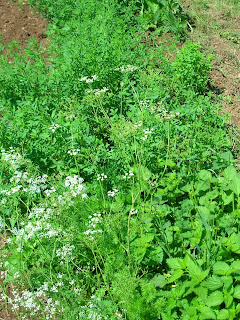


 In the lower garden, our green beans and baking beans, as well as our dry peas and shelling peas. As well as a row of Naked Seeded Pumpkins between the peas. We got a few inches of rain this week, warm nights, and a hot sunny day today, so everything is growing by inches.
 Next to them, the brassicas and ground cherries. The Flea Beetles never did make it down to the transplants, after giving my turnips and radishes a hard time. And now I can hardly find a Flea Beetle in the garden, I'm pretty sure the Soldier Beetles finished them off, their population exploded around the time the Flea Beetles' declined. The cutworms were beginning damage some of the brassicas, so we stuck small nails along side the stems to prevent them cutting the entire stem off, they still climb up and take a leaf here and there, but we scout these areas too, and dig them up.
 Hungarian Hot Wax and Carmen Peppers just starting to flower. We spike them with nails as well, to prevent any cutworm damage. We've been babying these peppers along for nearly 4 months now, I don't think I could stand to see one of them toppled.

 Our organic grain fields came up with a self-sown understory of red clover last summer. It did not bother the grain crops, and we had no problem harvesting the grains. Instead of being a "weed problem", it was beneficial, keeping the soil moist and loose, and providing a cover crop after harvest. We turned some new ground last fall, for grains this summer, so instead of turning the old grain fields under and planting them down to pasture, we decided to leave them come up in Red Clover and either graze or cut for hay this summer. This picture is of the Rye field we harvested last fall, with the old stalks intact. The cover crop of Red Clover overwintered, and to our surprise, the bits of Rye we left behind after harvest self-seeded this spring. We plan to cut this for hay as well, and would be able to graze it in the late fall as well.
 The same sad story of abuse and neglect can be read in the forest on this land. Again, it was clear-cut 20 years ago, and left to re-grow into a thick mass of tangled pioneer species. At this stage in it's growth, it is primarily young Poplar and Fir (80% of which is standing-dead or dying with dry-rot from overcrowding), with scattered young Maple, Birch, Spruce, Pine, and Ash. We burn a lot of Poplar, thinning out the crowded trees to make room for the hardwoods and longer-living Red and White Pines that used to dominate this area. In the process of cutting a logging road into the woods, we get a few cords of summer cord wood. Poplar is actually a great summer wood because it leaves no coals behind, allowing the stove, and the house, to cool down after the morning's cooking fire.




.JPG)