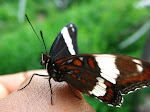
Here is the life cycle of the Seven Spotted Lady Beetle, our most numerous species:
 Adult, lays eggs in favorable sites.
 Larva, roams widely, preying primarily on aphids among other things.
 Larva transforms into a pupa, and while attatching itself to a leaf, it does yoga exercises, stretching up to the sun, then down into resting position.
 The pupa turn from yellow to this color patterning and stay put, about a week, before emerging as adults.
When pupation is complete, the beetle emerges...
 yellow and tender as a newborn.
 They seem to hang around the pupa casing until their shell begins to harden, trying out their newly acquired wings.
Just about the time they get their spots and start to turn from yellow to red, they abandon the dried casing, striking out into the garden for food.
 Aphids on a wheat stalk.
The balance between predator and prey is never static, population densities are always changing, typically following a pattern of alternating boom and bust. In the biological study of ecological communities, it has been observed that when prey populations spike, it will trigger a population explosion of predators, who will typically over-extend the limits of their food resources. Prey species will dwindle, followed by dwindling predator numbers. It's like a game of tag, predator population density seeming to lag behind. As I've mentioned before, it is this lag time that we, as gardeners, must make up for, keeping pest populations under control until the predators can catch up, and either take over for our job, or more typically, complement our efforts to keep pests in balance. And even trickier a gardener must allow enough pest/prey species to survive in order to encourage and support the lagging predators, without letting pests get out of control, damaging the food crops and exponentially exploding in the next generation. It is this balance that I am learning, and observing as I watch the relationship between the aphids and the Lady beetles in my garden.
Recent biology studies into the relationship between predator and prey have revealed some counter-intuitive interactions. The first study I heard (on a radio science show) on this topic, looked into the re-introduction of wolves into parks where they had been locally eradicated for decades. It was thought previously, as it would seem by my description above of the cyclical tag game, that the predators in any given area were a result of the number and type of prey in that area, and that the prey were a result of the availability and abundance of forage. So it was surprising for biologists to discover that it is the predator who largely shapes the landscape, and not the other way around.
To summarize the study, in the absence of predators, the elk and deer had browsed un-harassed, and therefore had selected feed and feeding areas along waterways and streams, to the point where young willows and other trees were grazed down, and stream banks were beginning to erode, and in some places, even dry up. Without predators, the herds grazed the land in different patterns, effecting the landscape and the flora. When the wolves were re-introduced, herds had to return to grazing in open landscapes where they could remain watchful. They shied away from dense clusters of trees, and only approached more exposed waterways where they could stay alert to the ever present danger, minimizing the sites where they entered the water. In a matter of years, the willows regained the stream banks, held the erosion, and kept the waters cool and flowing for the fish and amphibians. Grassland, and meadows started to open again, and clusters of young trees were allowed to grow into forests, supporting the diversity of birds, each of which depend of a specific variance of habitat.
This first study into the impact of wolves on the ecological community from which they had previously been evicted, led to further studies into the impact of predators on the landscape. A study into the impact of spiders on the flora of pastures and meadows revealed the same counter-intuitive result: the presence of spiders changed the feeding habits of insects, which selected for certain plant species that would otherwise be grazed down by herbivorous insects. So perhaps we have the tag-game inverted, and should rather look at it as predators in the lead, with prey species fitting into the spaces where they can best survive, and the landscape as the result of this interaction.
It is interesting to think upon a gardener as a sort of meta-predator in the garden. The landscape, or garden, is the direct result of the gardener's selection of insects and varieties of plants. All other predators are there as guests and allies, dependent on the gardener for prey and habitat. I can see this type of relationship in my garden, never more so than when I hand-pick certain pest species. Patrolling the garden every day for Colorado Potato Beetles and larva, and Imported Cabbage Moth caterpillars, I feel very much like a predator. These are the two pests in my garden that are both visible and can be easily hand-picked, and both can do a lot of damage to foliage if left unchecked. And because I have daily observations of the pest populations, I am also able to observe the populations of predators, which leads me to learn more about enlisting and encouraging the specific predators. This kind of daily observation also teaches me a lot about the life cycles, and seasonal cycles, of these insects (or avian, amphibious and reptilian predators).
I sometimes see my job in the garden as Ecological Wildlife Management. I try to keep things in balance, using a variety of techniques such as row cover and physical barriers, but the most effective techniques are preventative and supportive. (I find the same is true for our own physical health as is true for the garden health.) Prevention techniques revolve around proper rotation, and often require it, for example, in my second year of gardening, I put row cover over a spring crop of radishes to protect from Flea Beetles, but had not managed my rotations correctly. Not yet understanding the life cycle of Flea Beetles, I quickly found that the first generation of Flea Beetles emerged from the soil, under the row cover. I have never yet used an insecticide, and will continue to view it as a last result. Insecticides, including the Organically acceptable plant derivatives, resemble anti-biotics in their inability to distinguish between harmful pests and beneficial insects. And insecticides work against any supportive measures to encourage an intact biosphere of beneficial predators and their prey.
A garden invites intimate interactions with the garden ecology. While reading a 1977 Organic Gardening and Farming magazine, I came across an article written by a woman who understood this intimate relationship. She had been handpicking Hornworm caterpillars from her tomato plants, and stomping them underfoot, when she came across a parasitized caterpillar. She left this one to hatch out the parasitic wasps inside, but was inspired to collect the rest of the caterpillars into a tall bucket. She left the bucket in the garden, and continued to collect and feed the pests. The parasitic wasps had access to an abundance of hosts, and it did not take long before she was hatching out dozens and then hundreds of beneficial wasps.
When I walk through the potato patch and find more Lady beetles and larvae than I can find Colorado Potato beetles, I look at that as the best crop insurance that money can't buy. The toads and Garter snakes have provided the same invaluable crop insurance against slugs in the market garden this year. With 20 inches of rain between June and July, our garden would be overrun with slugs if not for these hungry predators. And I am happy to report that Lady Beetles will continue to find other sources of food when the aphids run short, including the eggs of moths and other beetles, and small invertebrates, which may explain the dramatic reduction in hatching Colorado Potato Beetles since the Lady Beetle population has exploded. I am beginning to find them in the Brassica plot, hoping they will find the Imported Cabbage Moth eggs to be a tasty treat, between the occasional aphid meal.


 The larger carrots can be selectively pulled from the row, making room and giving sunlight to the stragglers from replanting the gaps. I couldn't resist pulling a few early parsnips to go with the feast. The smell of freshly pulled parsnip roots and leaves reminds me of coconut. Didn't have any coconut milk in the house, but this is what the aroma inspired: carrots and parsnips sliced, steamed, cooked in butter, with chopped mint, peppermint and finely chopped dates. New favorite.


 We have potato flowers in varying shades from white to pink to lavender to blue, depending on the variety and corresponding with the color of the potato skin. As soon as these flowers begin to die back, I can begin to excavate some of the treasure trove beneath.
 Pea flowers are short lived and delicate creatures. This time of year, the pods seem to grow by inches straight out of the newly opened blossoms.
 Bean flowers remind me of orchids, perhaps the homely cousin, but beautiful still. And they continue to flower as young bean pods form, promising a reliable harvest, enough to put away for winter.
  Pumpkin and squash flowers glow like lanterns in the bare spring garden, and not surprisingly, they never fail to attract interesting insects for nectar, prey or shelter.
 And some vegetable flower are only ever seen in the seed saving garden. This globe of tiny onion flowers is wrapped in paper like the bulb below.

 We handpick the adult beetles (from 5-20 a day), and squish the little larvae when we see them, but surprisingly few larvae are either hatching or growing very large due to the numerous predators.
 Even the eggs are being eaten by something or other, it's hard to know who... they do look pretty tasty.
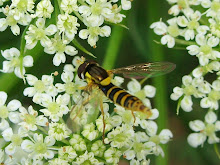
  It could be these Long-Legged Flies, numerous in the potato patch, they will eat both eggs and beetle larvae.


 Scavenging the ground level of the garden, I can hardly disturb the soil without finding one of these hard-working Ground Beetles. This is the largest, and earliest emerging Ground Beetle species in our garden. But it has been accompanied by two or three other species, including a smaller bronze colored one, and a smaller plain black one.
 And this iridescent species. This picture shows off their mouth parts, wouldn't want to be a soft-bodied insect in their way. They have been doing very well this year, feeding on the abundance of cutworms in the soil. I often disturb one dining on a grub, and in one heavily infested bed, where I found 100 cutworms, I disturbed about 25 Ground Beetles. Not a bad predator to prey ratio.
.JPG)

 And for a finale, the strangest critter found in the garden this spring: Strauzia longipennis, the Sunflower Maggot Fly. Entomologists must have a sense of humor. *giggle* Not surprisingly, it was found on the sunflowers, laying eggs on the undersides of the leaves. The eggs will develop into maggots, eating leaves or seeds, depending on the species. Until I hunted down the identification of this particular insect, I was unaware that sunflowers had a specific pest (besides Blue Jays), so I will be watching for any maggots or leaf damage on my sunflowers.
 Putting physical barriers, such as tin-foil or paper collars, around transplants is a common method of
  The morning after we put up the cutworm fence, we were happy to discover very little damage overnight. The herbs were untouched, and only a few carrot and parsnip leaves had been cut, exposing the location of the remaining cutworms. Thank goodness, it seems that my war with the cutworms is drawing to an end. Practicing organic and ecological gardening means out-smarting, and out-maneuvering pests and diseases. I tend to be of the disposition to lock horns and butt heads directly with my pest-sized opponent, but this time it was simply wearing me down. So I learned an important lesson in gardening: to be nimble and adaptable in technique and method, to use my intellect instead of sheer determination and will-power. Determination got me through the steep beginner's learning curve, but now that I've got a few seasons under my belt, it's time to sharpen my tools and think like a gardener!
 Other-where's in the garden, the perennial herb garden is flourishing, providing my first cut of Oregano, Thyme, Catnip and Alfalfa to dry for winter use.
 and a Monarch look-a-like: the Eastern Viceroy.


.JPG)